
Tsuki 突き Waza
The Japanese word Tsuki (突き) comes from the verb Tsuku (突く), meaning “to thrust” or “to jab.
”Pronunciation:
Tsuki - tsoo-keeThe Japanese syllable “Tsu” (つ) is pronounced as a single sound, with a soft “t” before “su.”
The word is therefore pronounced
“tsoo-kee.
”Seiken Tsuki (正拳突き)
Seiken Tsuki, also known as Choku Tsuki, is the fundamental straight punch in Karate. It is executed using
the first two knuckles of the fist while maintaining proper wrist alignment, hip rotation, and body coordination for maximum power and safety.
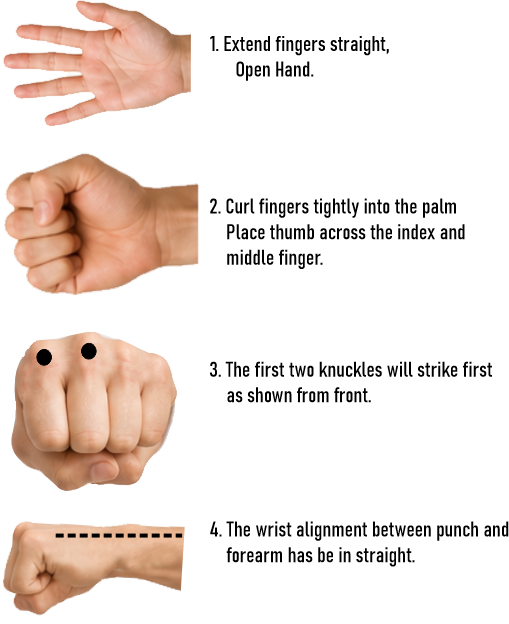
Proper Fist Formation
Keep the fingers straight and tightly together.
Curl the fingers tightly into the palm.
Place the thumb firmly across the index and middle fingers.
The punch strikes with the first two knuckles while the wrist remains straight to avoid injury.
Key Technical Points
The opposite hand pulls back to the hip (Hikite) as the punch extends.
The fist rotates during the punch so the palm faces downward at impact.
The body stays relaxed until the exact moment of contact, when the muscles tighten to produce focused power (Kime).
Target Levels
Jodan - Upper level (head/face)
Chudan - Middle level (torso/stomach)
Gedan - Lower level (groin/lower body)
Seiken Tsuki is one of the most fundamental techniques in traditional Karate, emphasizing precision, focus, control, and effective power generation.
Section: Technical Insight Title: Tsuki (突き)


