Category Archives: Techniques

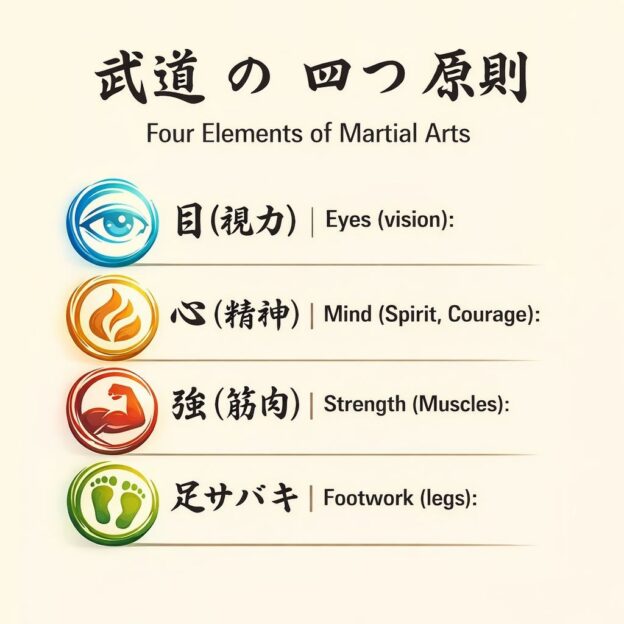
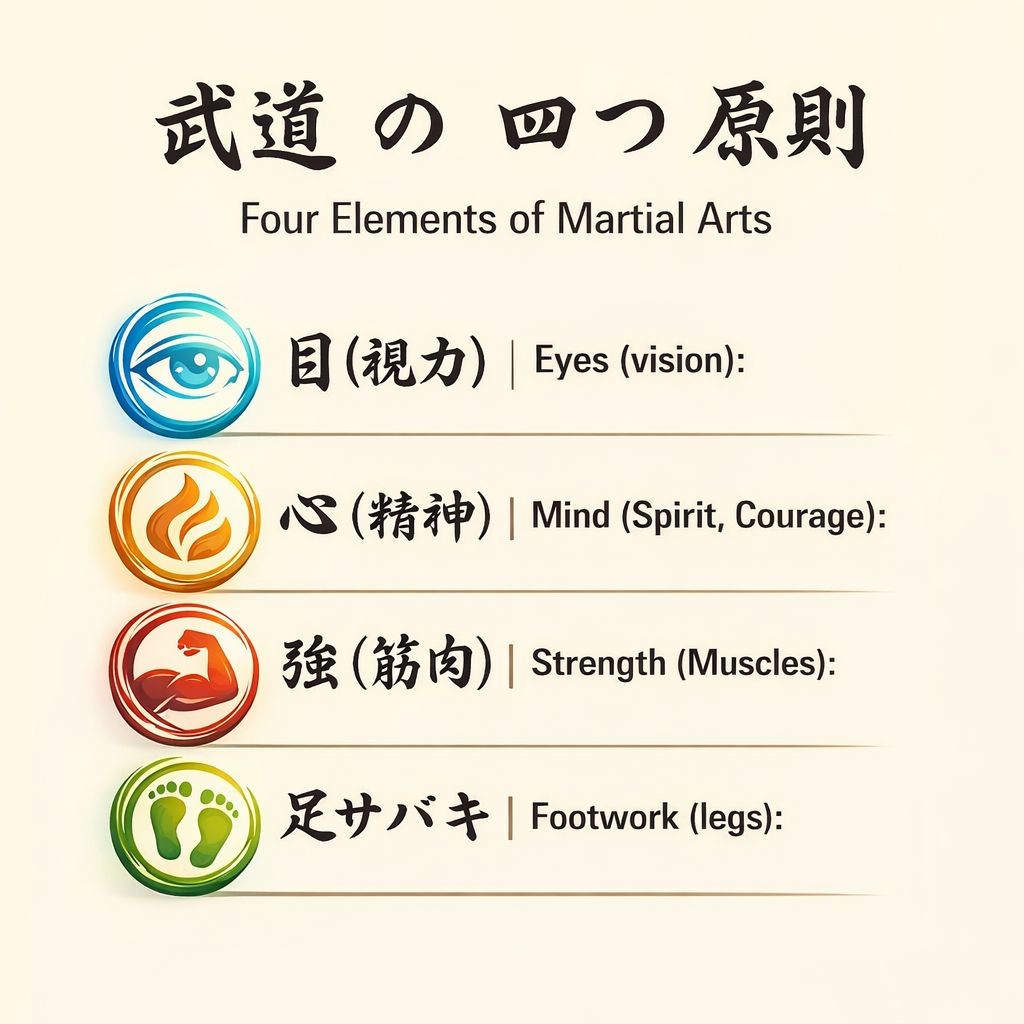
Four Elements of Martial Arts – 武道 の 四つ 原則

武道の四つ原則The Four Essential Principles of Martial ArtsThe four essential elements of martial arts, which also apply to Karate-Do, are fundamental principles that guide both technical development and mental discipline.

目 (Moku / Vision) – Eyes & Awareness
Keep your eyes focused on the opponent while carefully observing their movements and intentions. A martial artist must instantly analyze the surrounding environment, including terrain, distance, weather, and positioning. Proper awareness and advantageous positioning are the first steps toward success. Although eye contact can establish mental dominance, one should not focus only on the opponent’s eyes. Instead, maintain awareness of the entire body through peripheral vision. During Kihon and Kata practice, keep the gaze forward at eye level while remaining aware of the surroundings. Avoid looking down unnecessarily, as it reduces awareness and creates vulnerability.

心 (Kokoro / Seishin)
- Mind & Spirit
Mental strength develops courage, composure, and fighting spirit. A martial artist should remain calm, emotionally balanced, and mentally focused under pressure. Neither fear nor overexcitement should control the mind. A composed spirit allows clear judgment, decisive action, and the ability to respond effectively in any situation.

足捌き (Ashi Sabaki)
Footwork & Movement Efficient movement requires balance, speed, flexibility, and stability. Proper footwork is essential for both offense and defense.Maintain a low and stable center of gravity while moving naturally and continuously. Avoid remaining stationary for too long, as constant repositioning creates tactical advantage. Dragging the feet reduces mobility and speed, while excessive jumping can expose openings and weaken balance.

強 (Tsuyosa / Strength)
Physical Power Physical conditioning and muscular strength are necessary to generate effective power and endurance. The body must be trained to develop stamina, explosive movement, speed, and precision.Through disciplined and regular practice, strength becomes controlled, efficient, and fully integrated with technique.Together, these four principles form an essential foundation of martial arts training. Through continuous practice and self-discipline, they develop not only technical skill, but also character, awareness, and true martial spirit.

Section : Karate Techniques Insight   Title:  The Four Elements of Martial Art 武道 の 四つ 原則
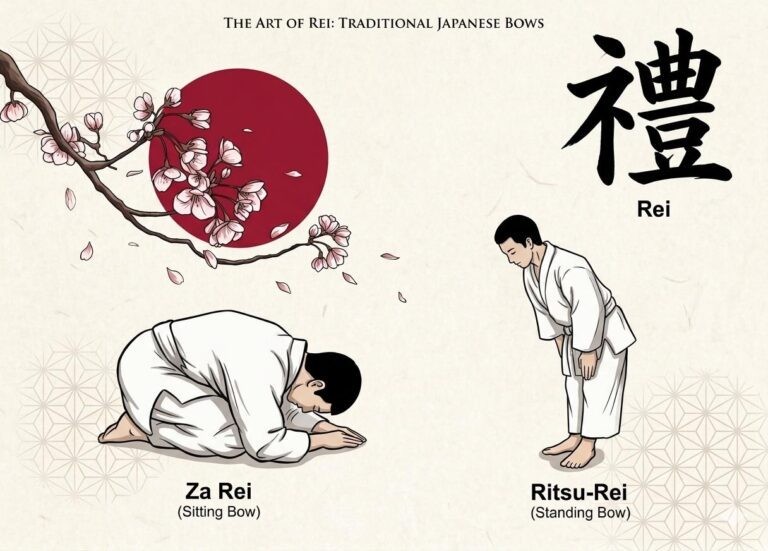
Reishiki 礼式 or Reigi 礼儀

The Spirit of Respect in Martial Arts Rei (礼) originates from the Japanese concept of Reigi, meaning respect, courtesy, and proper manners. In Japanese martial arts, Rei is far more than a formal bow  it is a fundamental principle that shapes the character and spirit of the practitioner.

The act of bowing expresses humility, discipline, and respect toward one’s Sensei, fellow practitioners, and the Dojo itself. Bowing before and after training also reinforces mutual trust and appreciation between training partners. However, Rei extends beyond physical gestures. It reflects an inner attitude of sincerity, gratitude, and awareness. Through the practice of Rei, martial artists cultivate respect not only within the Dojo, but also in daily life and human relationships. In essence, Rei forms the foundation of true martial spirit and proper Budo conduct.

Section: Technical Insight   Title: Reishiki 礼式 or Reigi 礼儀

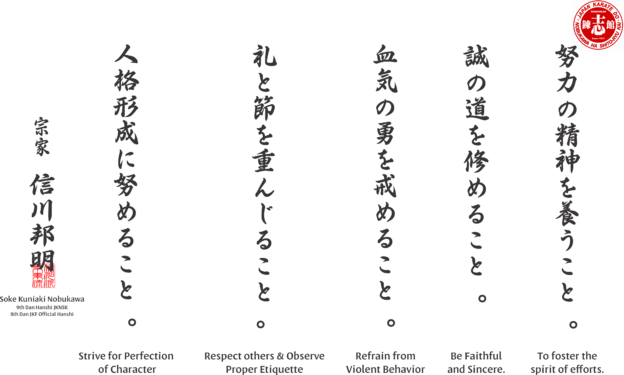
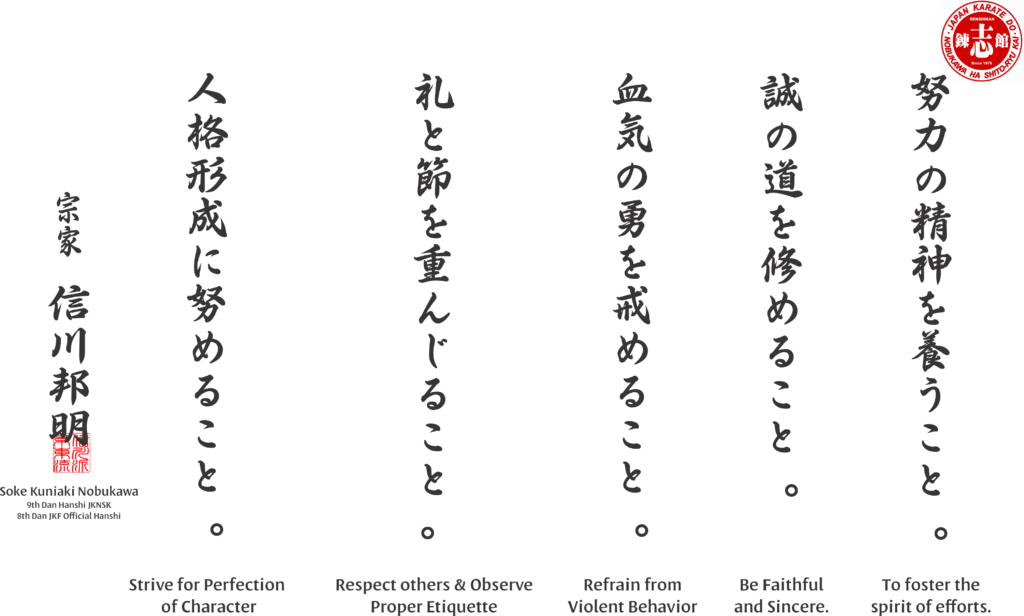
Dojo Kun 道場訓

Dojo Kun (道場訓) are the rules and guiding principles of the training hall in Japanese martial arts. They are usually displayed at the entrance or at the Shomen (front) of the dojo, and all students are expected to follow them with discipline and respect. In many traditional schools, the Dojo Kun is recited at the end of class to reinforce good character, humility, and proper conduct.

Section: Technical Insight   Title: Dojo Kun 道場訓

Sen-te 先手 – The Principle of Initiative in Martial Arts

Sen-te 先手) - The Principle of Initiative in Martial Arts

In martial arts, Sen-te 先手 refers to the initiative taken to control timing and response during combat. This principle is deeply rooted in the teachings of The Book of Five Rings by the legendary Japanese swordsman Miyamoto Musashi. Mastering Sen enables a practitioner to dominate the flow of engagement through precise timing, awareness, and strategy. There are three primary levels of Sen:

1. Go No Sen (後の先) – Defense and Counterattack
This is the foundational level of timing. The practitioner allows the opponent to initiate the attack and then responds by evading or blocking, followed by an immediate counterattack.
It develops awareness, patience, and reactive timing.

2. Sen No Sen (先の先) – Simultaneous Defense and Attack
At this intermediate level, the practitioner anticipates the opponent’s intention and responds by defending and attacking at the same time.
This requires sharper perception and timing than Go No Sen, as both actions occur simultaneously, placing the practitioner one step ahead.

3. Sen Sen No Sen (先先の先) – Pre-emptive Counterattack
This is the highest level of initiative. The practitioner senses the opponent’s intent even before the attack is fully executed and counters preemptively.
It demands exceptional timing, focus, alertness, and refined intuition, making it the most advanced and superior application of Sen.

Application in Karate Training
In Karate-Do practice, the progression of Sen reflects the student’s development:

Beginners should focus on Go No Sen, learning proper defense and immediate counterattacks.

Intermediate students progress to Sen No Sen, integrating simultaneous defense and offense.

Advanced practitioners refine Sen Sen No Sen, mastering anticipation and pre-emptive action. This structured progression not only enhances technical skill but also serves as a clear indicator of a practitioner’s growth in timing, reaction, and mental awareness.


Section: Technical Insight   Title: Sen-te (先手) 


Shinto-ryoku 浸透力

The concept of Shinto-ryoku 浸透力 explains the true striking effect of a karate technique. In modern Karate, there is often a strong emphasis on sport-based training, where techniques prioritize speed, light contact, and the withdrawal of strikes to avoid injury. While such training develops important attributes, it can also lead some Karateka away from the traditional path of Budo Karate, where techniques are intended to be decisive and effective, often expressed through the principle of Ikken Hissatsu -拳必殺  “to finish a conflict with a single well-executed strike.”

For Karateka who practice Karate as Budo and self-defense, understanding Shinto-ryoku is essential. It refers to the penetrative quality of a strike the ability to deliver force not merely onto the surface of a target, but deeply through it. When executing a technique, one should not think only of touching the opponent, but of driving the technique beyond the point of contact, allowing maximum transfer of energy at the moment of impact.

One practical method of studying this concept is through Tameshiwari (試し割り), or breaking techniques. For example, when striking multiple boards, the objective is not simply to break the top board, but to transmit force through the entire stack. This is achieved through correct structure, focus, body alignment, and follow-through, rather than stopping the strike at the surface. In this context, the idea of “penetration” serves as a training principle that prevents deceleration at impact and promotes efficient energy transfer.

In an actual fighting situation, a properly executed strike with correct mechanics and follow-through can remain highly effective even when the opponent attempts to block. The effectiveness does not come from brute strength alone, but from timing, accuracy, body coordination, and the efficient delivery of power.

The essence of Shinto-ryoku lies not in excessive muscular force, but in the correct use of body mechanics and total-body coordination. This includes hip rotation, proper posture and alignment, relaxation followed by focused contraction at the instant of impact, and a natural snapping motion that drives energy forward. When performed correctly, the technique will feel as though it penetrates through the target, making the strike both efficient and powerful.

Ultimately, Shinto-ryoku reflects one of the deeper principles of traditional Karate-do: the unity of technique, body mechanics, focus, and intention. It is not merely about hitting hard, but about delivering power with precision, control, and complete commitment.


Section: Technical Insight   Title:Shinto-ryoku 浸透力

Shin Gi Tai 心技体

Shin Gi Tai (心技体): The True Balance of Mind, Technique, and Body in Martial Arts

A proper balance of Shin Gi Tai (心技体) transforms an ordinary martial artist into an extraordinary one a true Sensei. Shin Gi Tai is a fundamental concept in Japanese martial arts, representing the harmonious development of three essential elements:

心 (Shin) – Mind, spirit, heart (Kokoro)
技 (Gi) – Technique, skill, art (Waza)
体 (Tai) – Body, physical condition (Karada)

These three pillars define the complete path of martial arts training and mastery.

心 (Shin) – The Mind & Spirit
Shin represents the mental and spiritual state of a martial artist during both training and combat. It includes: Focus and concentration Discipline and consistency Perseverance and resilience Calmness under pressure Fighting spirit. A strong Shin ensures clarity of thought, emotional control, and unwavering determination.

技 (Gi) – Technique & Skill
Gi refers to the development and refinement of technique. It involves: Mastery of Kihon Waza (fundamental techniques) Deep understanding of Kata (forms) Precise application through Bunkai (analysis and application) Correct principles behind each movement. True technical skill is achieved through consistent practice, precision, and proper understanding — not mere repetition.

体 (Tai) – The Body & Physical Ability
Tai represents physical strength and conditioning. It includes: Strength and power Stamina and endurance Flexibility and mobility Body conditioning Overall fitness. A well-developed body allows techniques to be executed efficiently, powerfully, and safely without injury.

The True Meaning of Shin Gi Tai (心技体)
Shin Gi Tai is not just a concept — it is the foundation of authentic martial arts. When mind, technique, and body are balanced, a martial artist achieves: True effectiveness Inner discipline technical excellence Long-term growth without balance, progress remains incomplete. Shin Gi Tai represents the complete development of a martial artist mentally, physically, and technically. Only through the harmony of these three elements can one move beyond mediocrity and walk the true path of Budo.

Section: Technical Insight   Title: Shin Gi Tai (心技体)

Tsuki 突き

Tsuki (突き)

The Japanese word Tsuki (突き) comes from the verb Tsuku (突く), meaning “to thrust” or “to jab.

”Pronunciation:
Tsuki - tsoo-keeThe Japanese syllable “Tsu” (つ) is pronounced as a single sound, with a soft “t” before “su.”

The word is therefore pronounced “tsoo-kee.

”Seiken Tsuki (正拳突き)
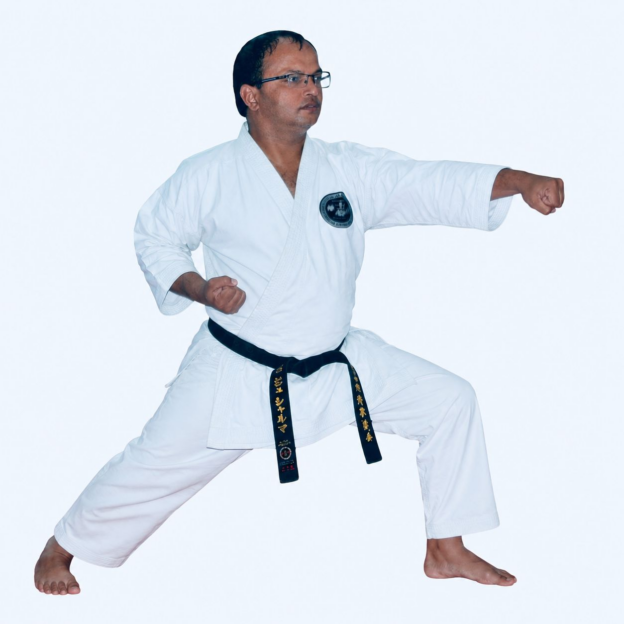
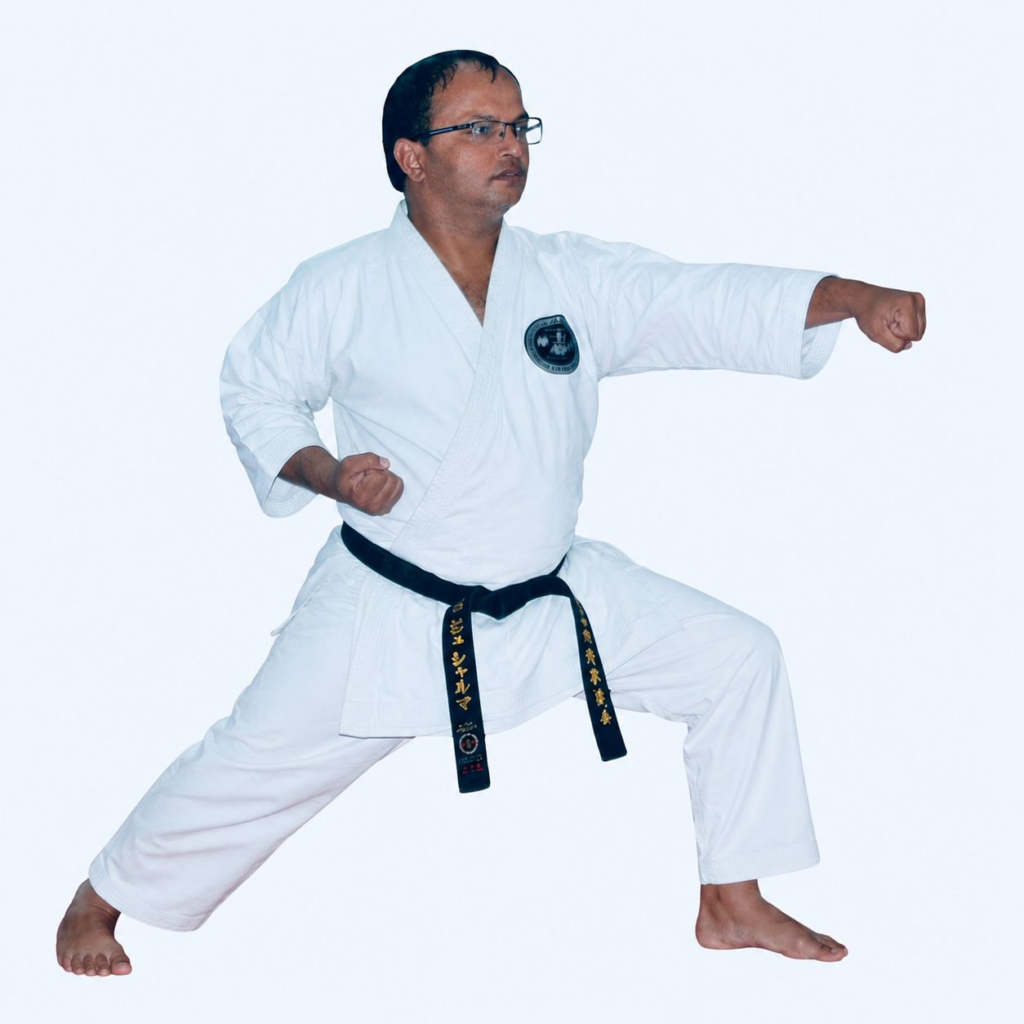
Seiken Tsuki, also known as Choku Tsuki, is the fundamental straight punch in Karate. It is executed using
the first two knuckles of the fist while maintaining proper wrist alignment, hip rotation, and body coordination for maximum power and safety.

Proper Fist Formation
Keep the fingers straight and tightly together.
Curl the fingers tightly into the palm.
Place the thumb firmly across the index and middle fingers.
The punch strikes with the first two knuckles while the wrist remains straight to avoid injury.

Key Technical Points
The opposite hand pulls back to the hip (Hikite) as the punch extends.
The fist rotates during the punch so the palm faces downward at impact.
The body stays relaxed until the exact moment of contact, when the muscles tighten to produce focused power (Kime).

Target Levels
Jodan - Upper level (head/face)
Chudan - Middle level (torso/stomach)
Gedan - Lower level (groin/lower body)

Seiken Tsuki is one of the most fundamental techniques in traditional Karate, emphasizing precision, focus, control, and effective power generation.

Section: Technical Insight   Title: Tsuki (突き)