
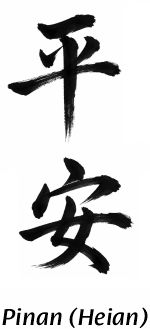
Heian (Pinan) 平安 Kata
The Heian (Pinan) Kata are the foundation of the Shuri-te lineage of Okinawan karate.
They were created by Anko Itosu between 1901–1908 to introduce karate systematically into Okinawan schools.
At the time, advanced kata such as Kusanku (Kosokun) were too difficult for beginners.
Itosu Sensei simplified and reorganized their principles into a progressive system that
developed:
* Strong stances and posture,
* Balance and coordination,
* Effective striking and blocking,
* Body movement and breathing,
* Mental composure,
* Disciplined character.
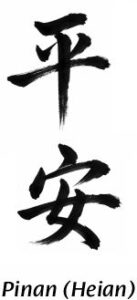
The original Okinawan name was Pinan (平安), later pronounced Heian in Japanese.
Its meaning reflects the true spirit of karate:* Hei (平) — peace, calmness* An (安) safety, tranquility.
Together, Heian means: “Peaceful Mind”“Calm and Tranquility”.
The Heian kata were never meant to be “basic” forms alone.
They were designed to build a calm, disciplined, and stable spirit.
Through repetition and refinement, the practitioner learns to move without panic,
think without confusion, and act with control rather than impulse.
A traditional saying state:“After mastering the Pinan kata, one can defend oneself confidently in most situations.”Among Itosu Sensei’s notable students was Kenwa Mabuni, who preserved these kata within Shito-ryu. They were later transmitted throughout modern karate systems, including the teachings of Gichin Funakoshi.Today, the Heian kata remain the essential foundation of traditional karate worldwide not only for technical development, but for cultivating discipline, composure, and inner tranquillity.
Section : Technical Insight Title: Heian (Pinan) 平安


