Author Archives: karateshitoryu

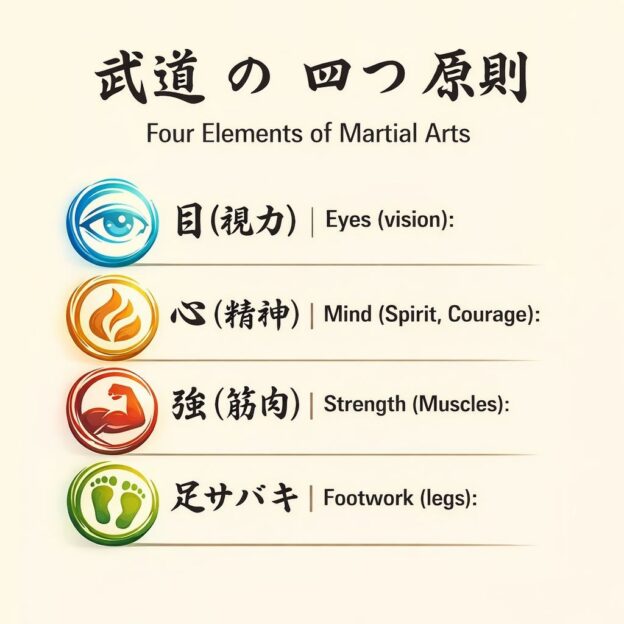
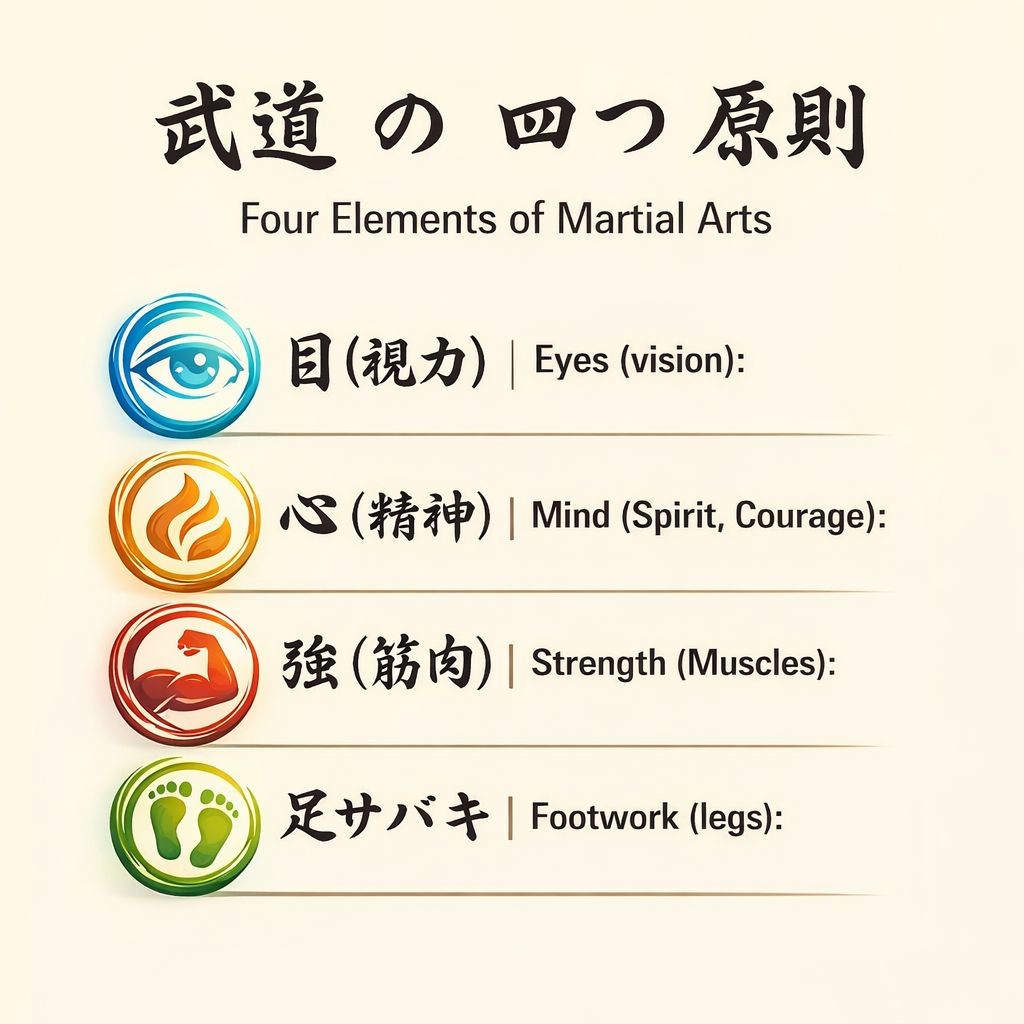
Four Elements of Martial Arts – 武道 の 四つ 原則

Four Elements of Martial Arts - 武道 の 四つ 原則

武道の四つ原則
The Four Essential Principles of Martial Arts

The four essential elements of
martial arts, which also apply to Karate-Do, are fundamental principles that guide both technical development and mental discipline.

目 (Moku / Vision) – Eyes & Awareness
Keep your eyes focused on the opponent while carefully observing their movements and intentions. A martial artist must instantly analyze the surrounding environment, including terrain, distance, weather, and positioning. Proper awareness and advantageous positioning are the first steps toward success. Although eye contact can establish mental dominance, one should not focus only on the opponent’s eyes. Instead, maintain awareness of the entire body through peripheral vision. During Kihon and Kata practice, keep the gaze forward at eye level while remaining aware of the surroundings. Avoid looking down unnecessarily, as it reduces awareness and creates vulnerability.

心 (Kokoro / Seishin)
- Mind & Spirit
Mental strength develops courage, composure, and fighting spirit. A martial artist should remain calm, emotionally balanced, and mentally focused under pressure. Neither fear nor overexcitement should control the mind. A composed spirit allows clear judgment, decisive action, and the ability to respond effectively in any situation.

足捌き (Ashi Sabaki)
Footwork & Movement Efficient movement requires balance, speed, flexibility, and stability. Proper footwork is essential for both offense and defense. Maintain a low and stable center of gravity while moving naturally and continuously. Avoid remaining stationary for too long, as constant repositioning creates tactical advantage. Dragging the feet reduces mobility and speed, while excessive jumping can expose openings and weaken balance.

強 (Tsuyosa / Strength)
Physical Power Physical conditioning and muscular strength are necessary to generate effective power and endurance. The body must be trained to develop stamina, explosive movement, speed, and precision. Through disciplined and regular practice, strength becomes controlled, efficient, and fully integrated with technique. Together, these four principles form an essential foundation of martial arts training. Through continuous practice and self-discipline, they develop not only technical skill, but also character, awareness, and true martial spirit.

Section : Karate Techniques Insight   Title:  The Four Elements of Martial Art 武道 の 四つ 原則

Sho – Go 称号 Titles in Karate

Sho-Go 称号 - Title in Martial Arts

Sho-Go
Sho Go is the traditional title system established by the Dai Nippon Butoku Kai to recognize and honor distinguished martial arts practitioners across various disciplines.

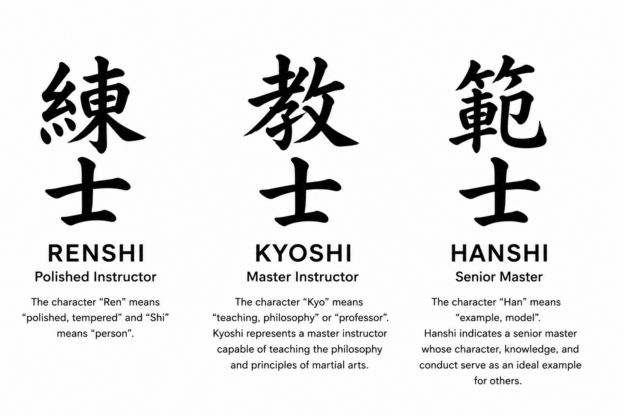
The three principal titles within the system are Renshi, Kyoshi, and Hanshi.

Over time, the Sho-Go system has been adopted by many martial arts styles and organizations, including the Japan Karate Federation (JKF), preserving its role as a respected traditional method of recognizing technical excellence, teaching ability, character, and contribution to the martial arts community.

Renshi (練士)
The character Ren means “polished” or “refined,” while Shi means “person.” Renshi represents a polished instructor who has demonstrated strong technical knowledge, teaching ability, and dedication to karate.

RequirementsMinimum rank of 6th DanMust hold a Shihan qualificationMinimum age of 35 years

Submission of a written thesis on karate technique, tactics, or philosophy (minimum 800 words) Successful completion of a practical demonstration related to the thesis subject

Kyoshi (教士)
The character Kyo refers to “teaching,” “philosophy,” or “professor.” Kyoshi represents a master instructor capable of transmitting not only technique, but also the deeper philosophy and principles of martial arts.

RequirementsMinimum rank of 7th DanMinimum age of 48 yearsMinimum of 6 years after attaining 7th DanMinimum of 6 years after receiving Renshi

Submission of a written thesis on karate technique, tactics, or philosophy (minimum 1200 words)Successful completion of a practical examination based on the thesis subject

Hanshi (範士)
The character Han means “example” or “model.” Hanshi refers to a senior master whose character, knowledge, and conduct serve as an ideal example for others. It is regarded as one of the highest traditional honors in Japanese martial arts.

RequirementsMinimum rank of 8th DanMinimum age of 58 yearsMinimum of 10 years after attaining 8th DanMinimum of 10 years after receiving Kyoshi

Submission of a written thesis on karate technique, tactics, or philosophy (minimum 2000 words)Successful completion of a practical demonstration based on the thesis subject.


Section : Karate Techniques Insight   Title: Sho-Go 称号 - Title in Martial Arts


Kata 型 / 形 – Forms | Patterns of Karate

Kata 型 / 形 - Forms | Patterns of Karate

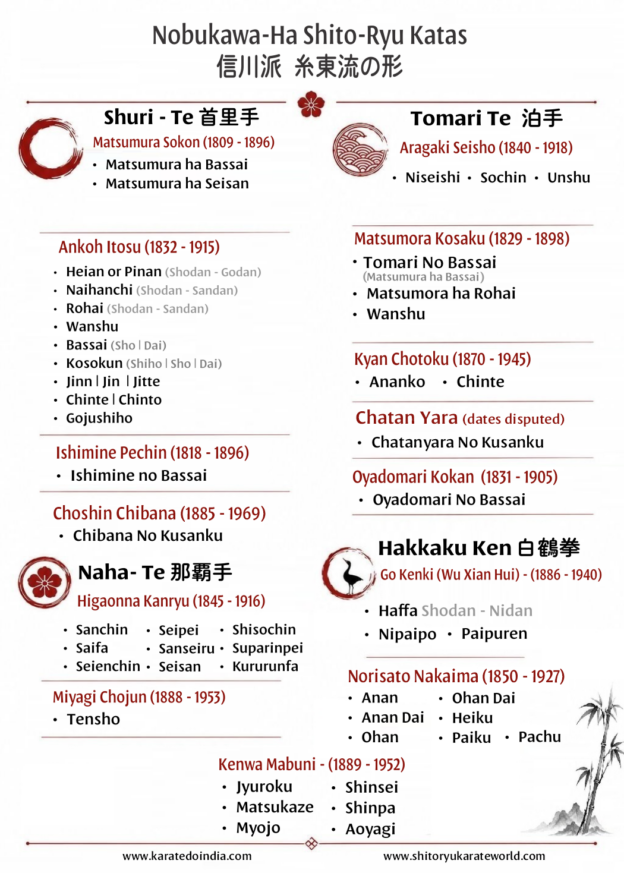
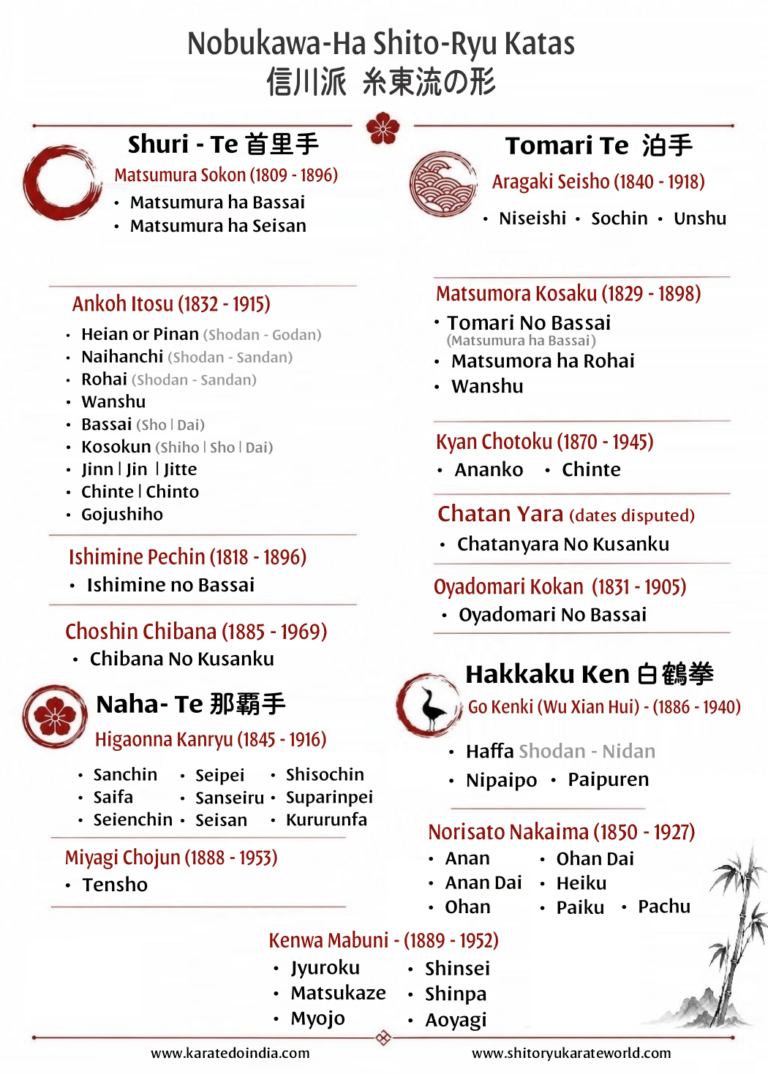
Kata (型 / 形) is a Japanese term meaning “form” or “pattern.” It refers to a structured sequence of martial arts techniques performed in a precise and choreographed manner. Kata serves as one of the most important methods for preserving and transmitting the traditional techniques and principles of martial arts from generation to generation.

Through regular practice of Kata, students develop:
Discipline | Precision | Balance | Coordination | Focus | Proper body mechanics

Kata training helps practitioners memorize, refine, and perfect techniques while cultivating mental concentration and physical control. Beyond physical movement, Kata also teaches rhythm, timing, breathing, awareness, and the practical application of techniques.Kata is not unique to Karate alone; it is also practiced in many traditional Japanese martial arts such as Iaido, Judo, Kendo, and Kenpo.On the left side, you will find the list of Kata that we practice and teach as part of our training curriculum.

Section updated in: Technical Insight  Title: Shito-Ryu Kata 型 or 形 

Tsuki 突き

Tsuki 突き Waza

The Japanese word Tsuki (突き) comes from the verb Tsuku (突く), meaning “to thrust” or “to jab.

”Pronunciation:
Tsuki - tsoo-keeThe Japanese syllable “Tsu” (つ) is pronounced as a single sound, with a soft “t” before “su.”

The word is therefore pronounced
“tsoo-kee.

”Seiken Tsuki (正拳突き)
Seiken Tsuki, also known as Choku Tsuki, is the fundamental straight punch in Karate. It is executed using
the first two knuckles of the fist while maintaining proper wrist alignment, hip rotation, and body coordination for maximum power and safety.

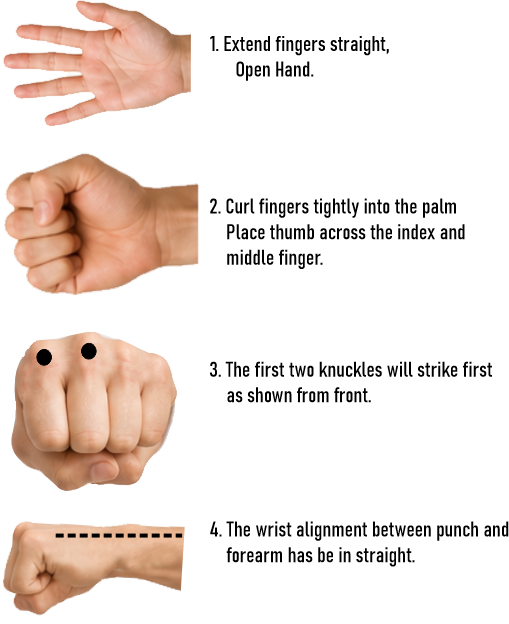
Proper Fist Formation
Keep the fingers straight and tightly together.
Curl the fingers tightly into the palm.
Place the thumb firmly across the index and middle fingers.
The punch strikes with the first two knuckles while the wrist remains straight to avoid injury.

Key Technical Points
The opposite hand pulls back to the hip (Hikite) as the punch extends.
The fist rotates during the punch so the palm faces downward at impact.
The body stays relaxed until the exact moment of contact, when the muscles tighten to produce focused power (Kime).

Target Levels
Jodan - Upper level (head/face)
Chudan - Middle level (torso/stomach)
Gedan - Lower level (groin/lower body)

Seiken Tsuki is one of the most fundamental techniques in traditional Karate, emphasizing precision, focus, control, and effective power generation.

Section: Technical Insight   Title: Tsuki (突き)

Shinto-ryoku 浸透力

Shinto-ryoku 浸透力

The concept of Shinto-ryoku 浸透力 explains the true striking effect of a karate technique. In modern Karate, there is often a strong emphasis on sport-based training, where techniques prioritize speed, light contact, and the withdrawal of strikes to avoid injury. While such training develops important attributes, it can also lead some Karateka away from the traditional path of Budo Karate, where techniques are intended to be decisive and effective, often expressed through the principle of Ikken Hissatsu -拳必殺  “to finish a conflict with a single well-executed strike.”

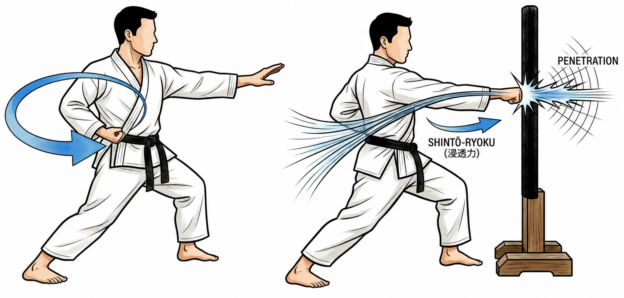
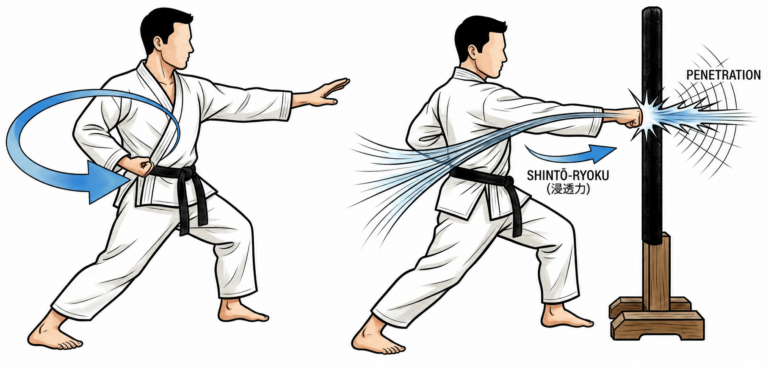
For Karateka who practice Karate as Budo and self-defense, understanding Shinto-ryoku is essential. It refers to the penetrative quality of a strike the ability to deliver force not merely onto the surface of a target, but deeply through it. When executing a technique, one should not think only of touching the opponent, but of driving the technique beyond the point of contact, allowing maximum transfer of energy at the moment of impact.

One practical method of studying this concept is through Tameshiwari (試し割り), or breaking techniques. For example, when striking multiple boards, the objective is not simply to break the top board, but to transmit force through the entire stack. This is achieved through correct structure, focus, body alignment, and follow-through, rather than stopping the strike at the surface. In this context, the idea of “penetration” serves as a training principle that prevents deceleration at impact and promotes efficient energy transfer.

In an actual fighting situation, a properly executed strike with correct mechanics and follow-through can remain highly effective even when the opponent attempts to block. The effectiveness does not come from brute strength alone, but from timing, accuracy, body coordination, and the efficient delivery of power.

The essence of Shinto-ryoku lies not in excessive muscular force, but in the correct use of body mechanics and total-body coordination. This includes hip rotation, proper posture and alignment, relaxation followed by focused contraction at the instant of impact, and a natural snapping motion that drives energy forward. When performed correctly, the technique will feel as though it penetrates through the target, making the strike both efficient and powerful.

Ultimately, Shinto-ryoku reflects one of the deeper principles of traditional Karate-do: the unity of technique, body mechanics, focus, and intention. It is not merely about hitting hard, but about delivering power with precision, control, and complete commitment.


Section: Technical Insight   Title:Shinto-ryoku 浸透力
Tachikata たち型

Tachikata (立ち方) – The Foundation of Karate Stances

It refers to the stances and lower body positions used in Karate. Correct body positioning and balance form the foundation of effective karate techniques. Powerful, accurate, smooth, and fast techniques can only be executed through stable and well-structured stances.

A Karateka must maintain a strong and balanced position without becoming rigid, while also being able to transition smoothly from one stance to another. Proper stances develop stability, mobility, balance, and the efficient generation of power.

Stances may be classified according to:
High and one-leg stances
Middle-high and lower stances
The alignment of the feet, knees, and center of gravity


Different stances also utilize varying forms of leg tension:
Inside tension such as in Sanchin-dachi 
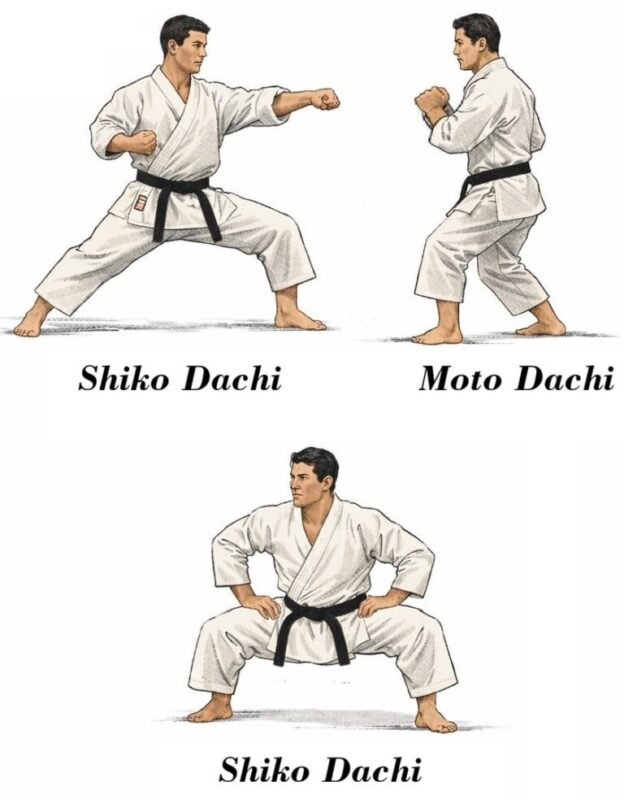
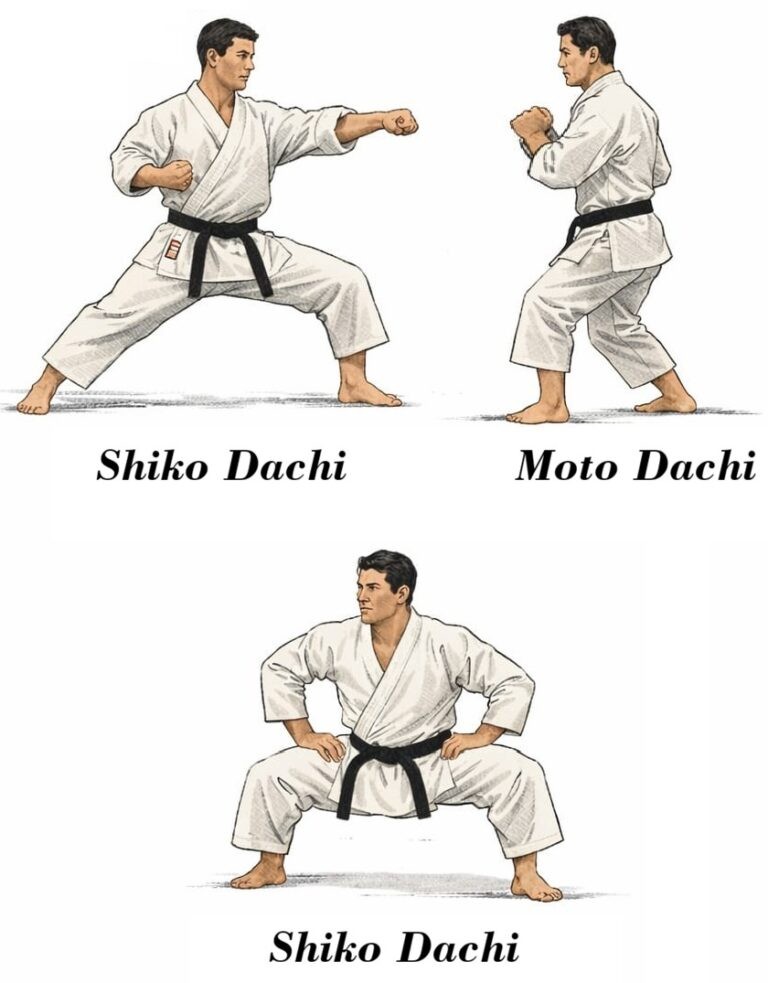
Outside tension - such as in Shiko-dachi

Important Principles of Stances
Soles of the Feet : The ball of the foot or the full sole, depending on the stance, should maintain firm contact with the floor for stability and grip.
Ankles : The ankles must remain flexible and strong to support body weight and movement efficiently.
Knees: The knees should bend naturally in the direction of the toes while maintaining proper alignment.Leg Tension: The legs should apply appropriate inward or outward tension according to the requirements of the stance.
Hips Position: The hips must remain correctly aligned to maintain posture, balance, and effective technique execution.
Center of Gravity: Lowering the center of gravity increases stability and strength. The Hara (Tanden) located below the navel, should remain engaged to improve balance, body control, and power generation.

Types of Stances : To perform any stance correctly:
Lower the center of gravity by bending the knees
Maintain correct posture and alignment
Apply proper inward or outward leg tension


High & One-Leg Stances

Heisoku-dachi (閉足立) – Joined feet stance
Musubi-dachi (結び立) – Heels together with toes outward
Heiko-dachi (平行立) – Parallel stance
Soto-hachiji-dachi – Toes pointed outward
Uchi-hachiji-dachi – Heels pointed outward
Sagi-ashi-dachi (鷺足立) – Heron stance
Tsuru-ashi-dachi (鶴足立) – Crane stance
Uki-ashi-dachi – Floating one-leg stance

Middle-High Stances
Naihanchi-dachi (内歩進立) – Wide parallel stance with inward knee tension
Moto-dachi (基立) – Basic or fighting stance
Sanchin-dachi (三戦立) – Hourglass stance
Han Zenkutsu-dachi (半前屈立) – Half front stance
Seisan-dachi (十三立) – Universal stance
Renoji-dachi (レの字立) – L-shaped stance

Lower Stances
Kosa-dachi (交差立) – Cross stance
Kokutsu-dachi (後屈立) – Back stance
Shiko-dachi (四股立) – Sumo stance
Zenkutsu-dachi (前屈立) – Front stance
Nekoashi-dachi (猫足立) – Cat stance
Katahiza-dachi (片膝立ち) – One-knee stance.

Through disciplined and regular practice, Tachikata develops stability, mobility, balance, and the ability to generate effective power, forming an essential foundation of traditional Karate-Do.

Section : Technical Insight   Title: Tachikata たち型


Shin Gi Tai 心技体

Shin Gi Tai 心技体

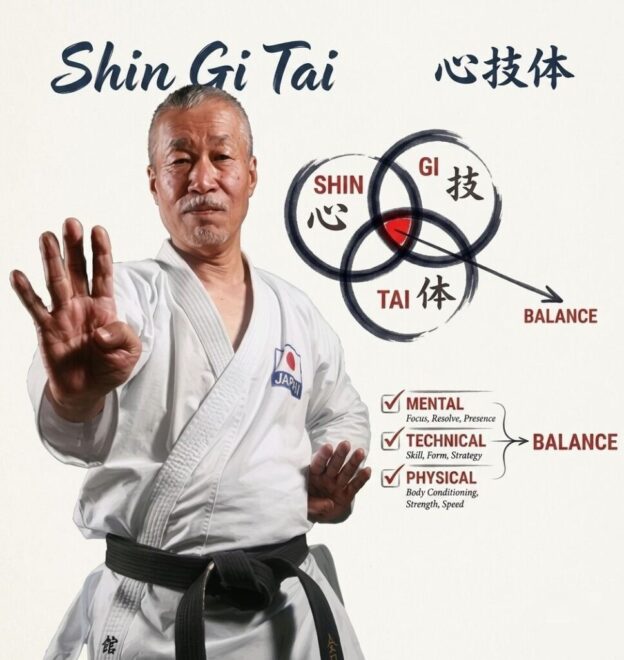
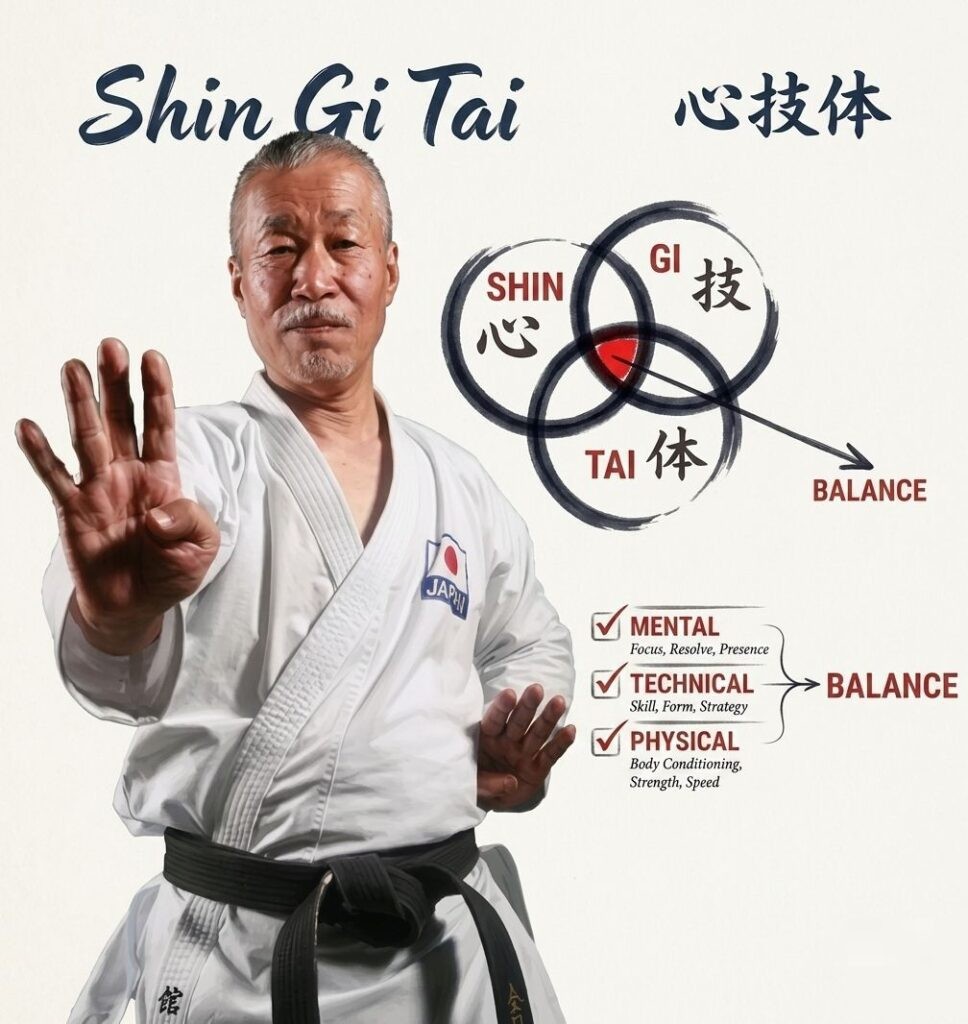
Shin Gi Tai (心技体): The True Balance of Mind, Technique, and Body in Martial Arts

A proper balance of Shin Gi Tai (心技体) transforms an ordinary martial artist into an extraordinary one a true Sensei. Shin Gi Tai is a fundamental concept in Japanese martial arts, representing the harmonious development of three essential elements:

心 (Shin) – Mind, spirit, heart (Kokoro)
技 (Gi) – Technique, skill, art (Waza)
体 (Tai) – Body, physical condition (Karada)

These three pillars define the complete path of martial arts training and mastery.

心 (Shin) – The Mind & Spirit
Shin represents the mental and spiritual state of a martial artist during both training and combat. It includes: Focus and concentration Discipline and consistency Perseverance and resilience Calmness under pressure Fighting spirit. A strong Shin ensures clarity of thought, emotional control, and unwavering determination.

技 (Gi) – Technique & Skill
Gi refers to the development and refinement of technique. It involves: Mastery of Kihon Waza (fundamental techniques) Deep understanding of Kata (forms) Precise application through Bunkai (analysis and application) Correct principles behind each movement. True technical skill is achieved through consistent practice, precision, and proper understanding — not mere repetition.

体 (Tai) – The Body & Physical Ability
Tai represents physical strength and conditioning. It includes: Strength and power Stamina and endurance Flexibility and mobility Body conditioning Overall fitness. A well-developed body allows techniques to be executed efficiently, powerfully, and safely without injury.

The True Meaning of Shin Gi Tai (心技体)
Shin Gi Tai is not just a concept — it is the foundation of authentic martial arts. When mind, technique, and body are balanced, a martial artist achieves: True effectiveness Inner discipline technical excellence Long-term growth without balance, progress remains incomplete. Shin Gi Tai represents the complete development of a martial artist mentally, physically, and technically. Only through the harmony of these three elements can one move beyond mediocrity and walk the true path of Budo.

Section: Technical Insight   Title: Shin Gi Tai (心技体)

Genealogical Karate Chart 系図

Genealogical Karate Chart 系図

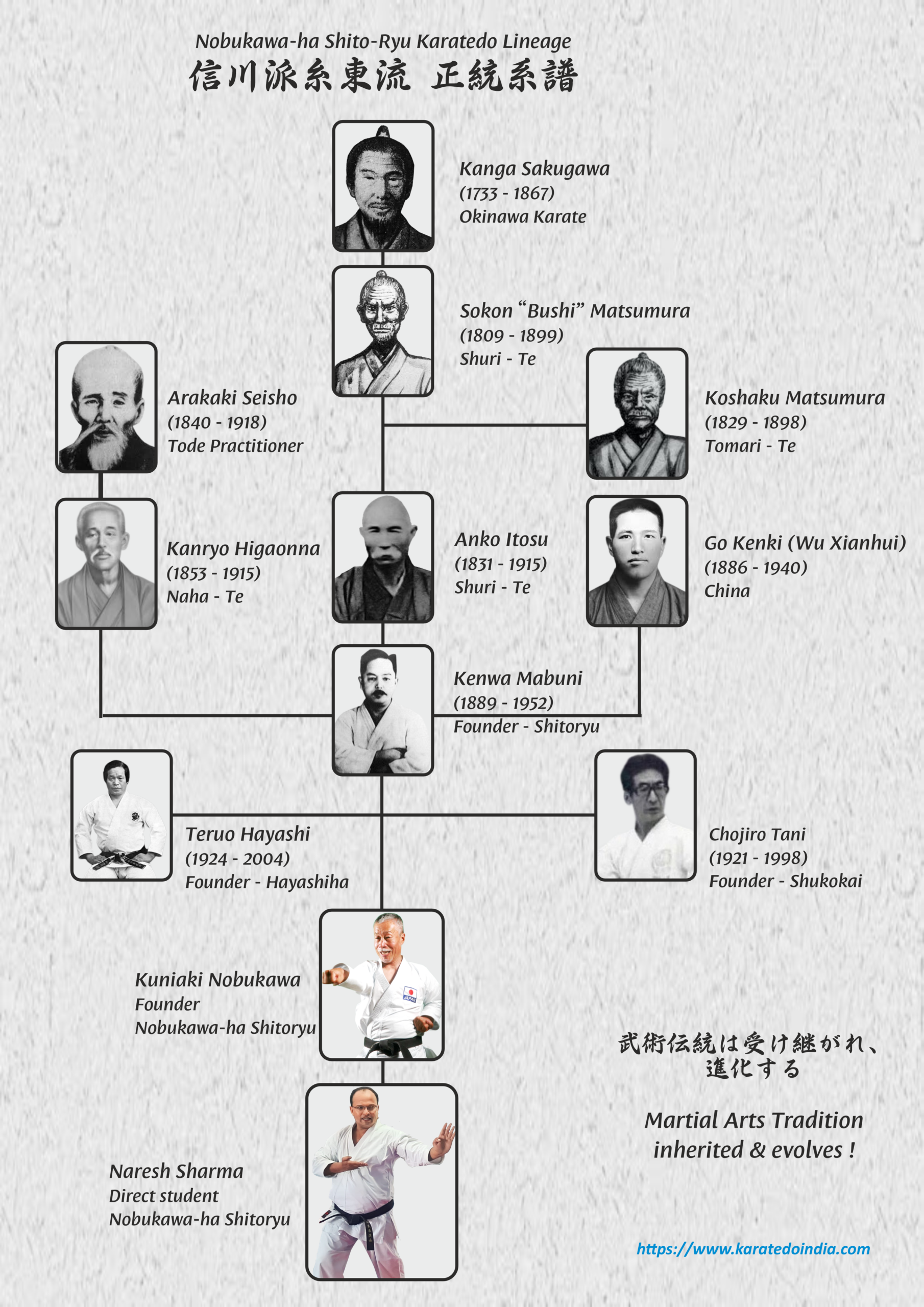
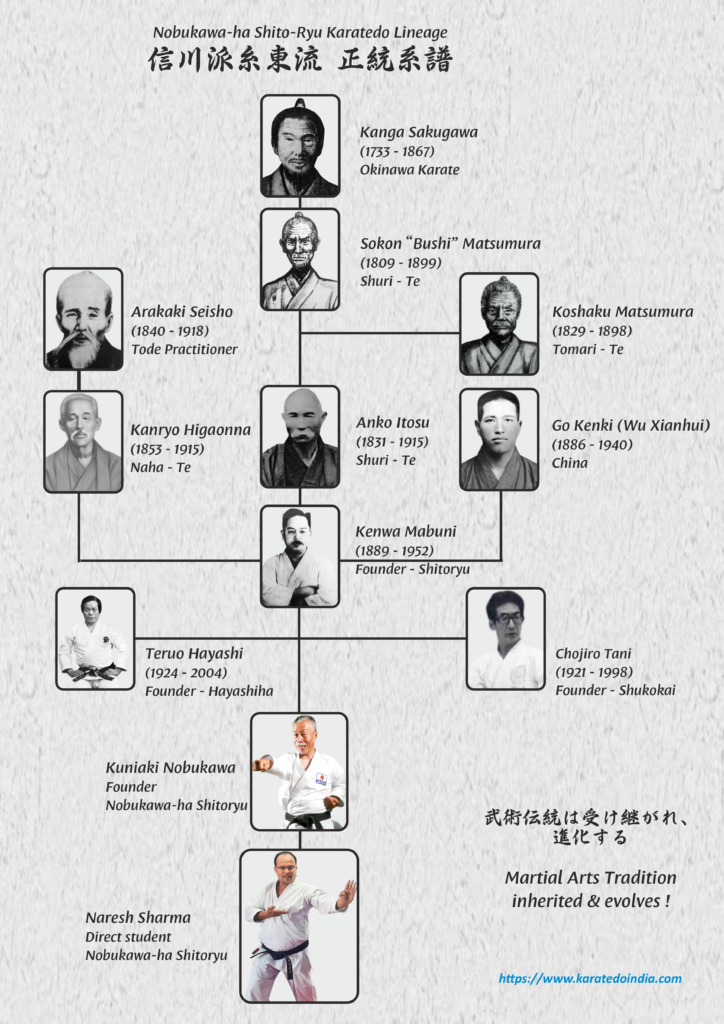
Importance of Lineage in Nobukawa-ha Shito-Ryu Karate
By Naresh Sharma

In Nobukawa-ha Shito-Ryu Karate, lineage (Keizu 系図) represents the authentic transmission of traditional Karate from master to student across generations. From Kenwa Mabuni through master's such as Teruo Hayashi, Chojiro Tani, and Kuniaki Nobukawa, the art has been preserved with technical precision, discipline, and true Budo spirit.

Lineage safeguards the authenticity of Kata, Bunkai, and traditional teachings, ensuring that Karate is practiced as originally intended. In an era of constant modification, lineage remains a symbol of credibility, responsibility, and respect for tradition.

More than history, lineage carries the true spirit of Karate-Do - Rei (respect), Gi (righteousness), Shin (honesty), and Yu (courage) - preserving the legacy of genuine Karate for future generations.

Section updated in: Technical Insight  Title: Genealogical karate-chart 系図

Sensei Teacher 先生

Sensei Teacher 先生

The Importance of the Sensei Student Relationship in Karate-Do

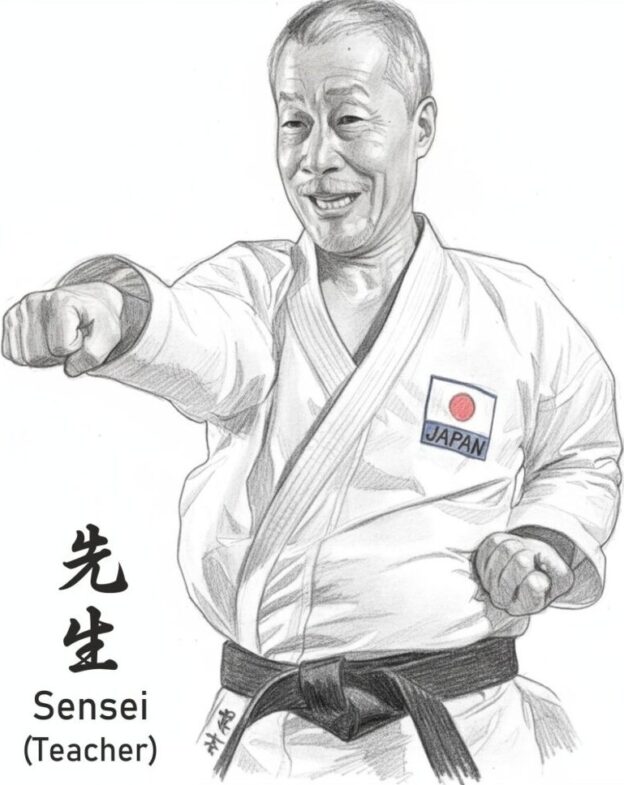
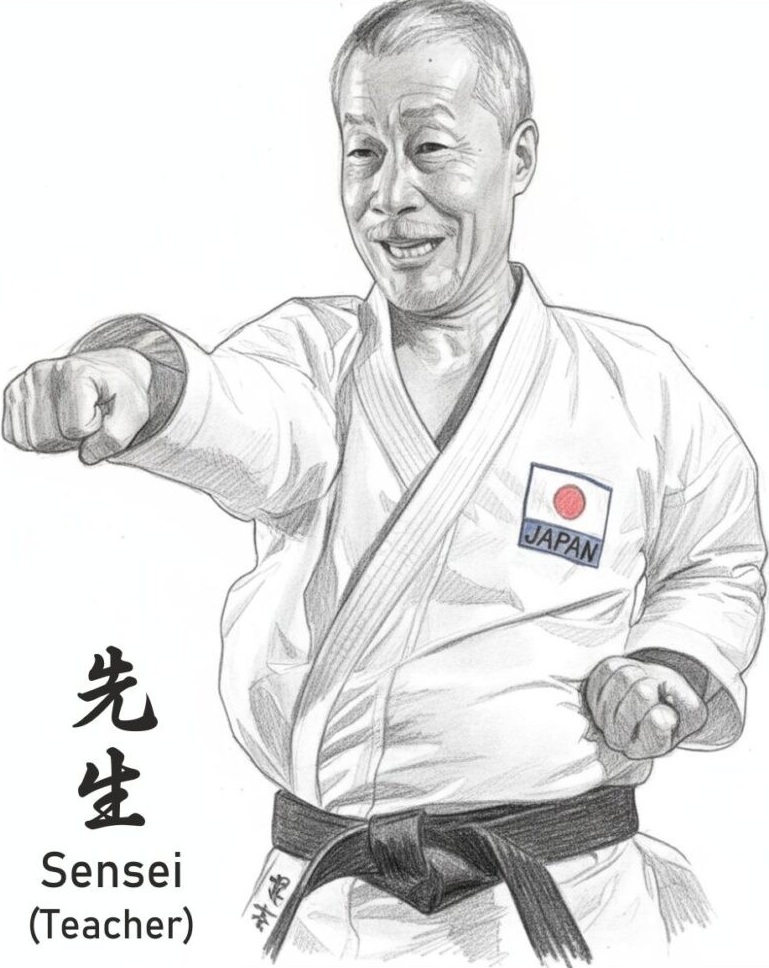
The relationship between a Sensei and student is one of the foundations of traditional Karate-Do. True martial arts cannot be taught through words alone; they require direct guidance, demonstration, correction, and shared practice.

A skilled Sensei not only teaches techniques, but also shapes the student’s discipline, attitude, character, and understanding of Budo spirit. Through close observation and proper instruction, the teacher helps students refine both their physical and mental development.

At the same time, students learn by observing the actions, behavior, and example set by their Sensei. This mutual trust and respect strengthen the bond within the Dojo and preserve the true spirit of martial arts.

Ultimately, the Sensei student relationship is not only about learning techniques — it is a path of self-cultivation, discipline, and lifelong growth in Karate-Do.

Section : Technical Insight   Title: Sensei (Teacher) 先生

Sen-te 先手 – The Principle of Initiative in Martial Arts

Sen-te 先手 - The Principle of Initiative in Martial Arts

Sen-te 先手) - The Principle of Initiative in Martial Arts

In martial arts, Sen-te 先手 refers to the initiative taken to control timing and response during combat. This principle is deeply rooted in the teachings of The Book of Five Rings by the legendary Japanese swordsman Miyamoto Musashi. Mastering Sen enables a practitioner to dominate the flow of engagement through precise timing, awareness, and strategy. There are three primary levels of Sen:

1. Go No Sen (後の先) – Defense and Counterattack
This is the foundational level of timing. The practitioner allows the opponent to initiate the attack and then responds by evading or blocking, followed by an immediate counterattack.
It develops awareness, patience, and reactive timing.

2. Sen No Sen (先の先) – Simultaneous Defense and Attack
At this intermediate level, the practitioner anticipates the opponent’s intention and responds by defending and attacking at the same time.
This requires sharper perception and timing than Go No Sen, as both actions occur simultaneously, placing the practitioner one step ahead.

3. Sen Sen No Sen (先先の先) – Pre-emptive Counterattack
This is the highest level of initiative. The practitioner senses the opponent’s intent even before the attack is fully executed and counters preemptively.
It demands exceptional timing, focus, alertness, and refined intuition, making it the most advanced and superior application of Sen.

Application in Karate Training
In Karate-Do practice, the progression of Sen reflects the student’s development:

Beginners should focus on Go No Sen, learning proper defense and immediate counterattacks.

Intermediate students progress to Sen No Sen, integrating simultaneous defense and offense.

Advanced practitioners refine Sen Sen No Sen, mastering anticipation and pre-emptive action. This structured progression not only enhances technical skill but also serves as a clear indicator of a practitioner’s growth in timing, reaction, and mental awareness.


Section: Technical Insight   Title: Sen-te (先手)